The guide
My Grok Bot Overnight Setup
How I put the AI compute I already pay for to work while I sleep, plus the exact message I send before bed.
01 The short version
I pay for Claude Code and Codex, and most nights those plans just sat there doing nothing. So I set up Grok Bot to hand them work while I'm away from my desk.
One night a stranger booked a call with me for noon the next day. At 10:25 PM I told my main bot "let it rip" and went to bed. By 7 AM my agents had built him a custom demo, and on the call I closed a $2,000 deal. The compute came to about $28 at list price, and it all ran on seats I was already paying for.
It wasn't perfect, though. It stalled at 4 AM, and I'm showing you that part too because the fix is the most useful thing in here.
02 My Grok Bot team
These are the bots you saw in the video. Each one owns one job.
Prime: the one I talk to
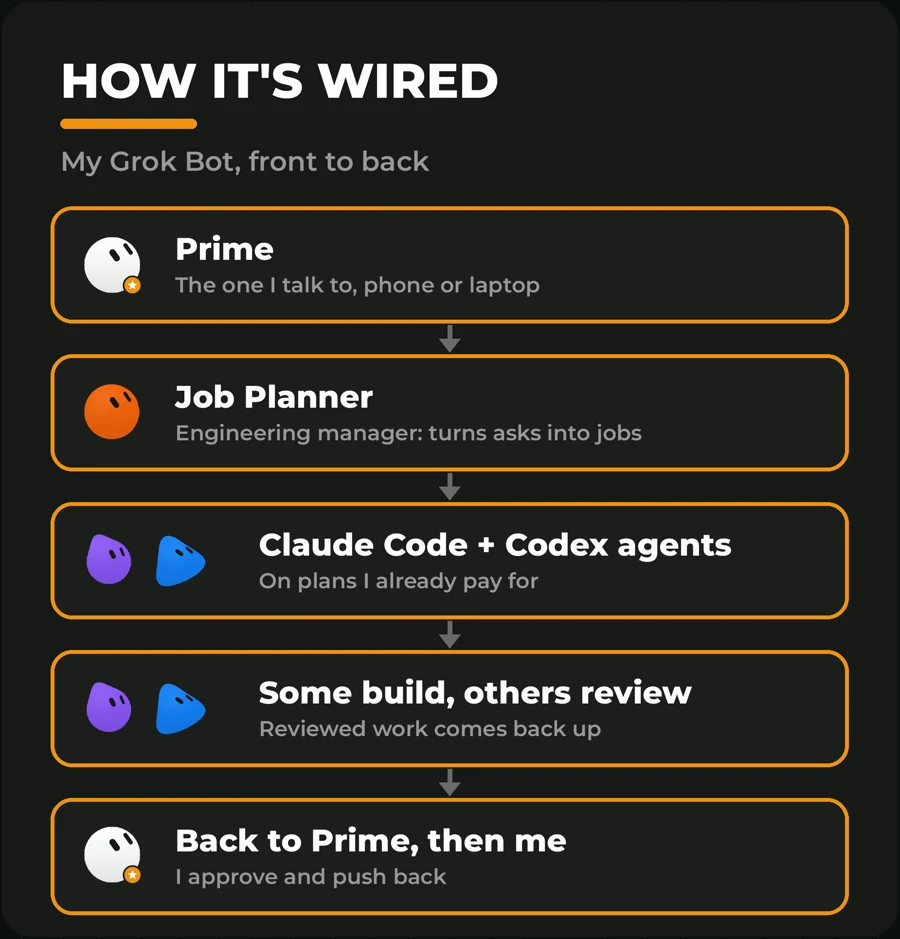
Prime's my main agent. I talk to it all day from my phone or laptop, and when I ask for something, it picks the bot that should own it and hands it over. On weekdays it checks my inbox and bookings every couple of hours and only pings me when something's actually new.
Hands work to: Job Planner for anything that needs building, and the other bots for the rest.
Job Planner: my engineering manager
Job Planner is in charge of all my engineering compute, meaning my Claude Code seats and Codex plans. It's the only bot allowed to turn a request into worker jobs. Every job gets a written pass or fail test before any work starts, and a second agent on a different model checks the result. It plans a day queue in the afternoon and adds the overnight jobs around 9 PM.
Hands work to: workers to build, checkers to verify, then the finished work back to Prime.
Closer: sales
Closer owns every live sales conversation, from the first real reply until I get paid. A few times a weekday it checks for replies and drafts my answer or a call brief. After a call, it asks Job Planner for a demo of exactly what the buyer asked for. Every email it writes lands as a draft that I send myself.
Hands work to: Job Planner for demos, and me for every send.
Content: marketing
Content drafts my posts in my voice, built from real stuff that happened that week: a LinkedIn draft each weekday morning, a YouTube idea pick on Mondays and Reel scripts twice a week. I approve the exact wording and post everything myself. When a video needs editing, it goes to Job Planner as a worker job.
Hands work to: Job Planner for edits, and me for approval.
Delivery: client work
Delivery preps everything for paid work like a workshop or a training session. That means the deck, demo data (public or made up, never a client's real data), the run of show and the follow-up handout. It keeps one folder per client so I can find everything later, and nothing client-facing goes out until I've approved the wording.
Reports to: Prime.
Workers and checkers
These are Claude Code and Codex agents running on plans I already pay for, and Job Planner is the only one who gives them work. Some build. Others check what the builder just made, and the checker always runs on a different model: if Opus built it, Sonnet, Fable or Codex checks it.
Here's the checker prompt I'd start with:
You didn't build this. Check the actual files and output against the "done means" list and ignore the builder's summary. List anything missing or made up. Pass it only if every item checks out. Otherwise send it back with exactly what to fix.03 Who talks to whom
- Me and Prime. Prime's the only bot I talk to day to day.
- Prime to everyone else. Builds go to Job Planner; sales, content and client work go to Closer, Content or Delivery.
- Closer and Content to Job Planner whenever they need something built, like a demo or a video edit.
- Job Planner to workers to checkers. Anything that fails goes back to the worker with exactly what to fix. Anything that passes goes back up to Prime, and Prime tells me.
The one rule that never changes: nothing reaches a real person without my OK. The bots draft emails and DMs all day, but I approve the exact wording and hit send myself.
04 The night it happened
- Prime tells me someone just booked a call for noon tomorrow.
- I tell Prime "let it rip." Same minute, Prime reads what he wrote on the booking form and hands the job to Job Planner.
- Job Planner sends a plan back first, before any work starts. It breaks the work into jobs, reuses skills I'd already built and marks the demo as the top job, due before 11 AM.
- I check in. Prime says it's running and I can go to sleep.
- The main build is done.
- I wake up and ask what's happening. Prime says nothing's moving. The worker never marked itself done, so nothing told Prime to pick it back up.
- It's fixed its own checking and gotten everything moving again.
- A checker agent catches a build that would've failed QA and sends it back before anyone sees it.
- All the demos are done.
- I take the call myself, show him the before and after, and close the deal.
The whole night came to about $28 of compute at list price, on seats I already pay for. I sent 8 messages and wrote zero lines of code.
05 The loop to copy
- Ask Prime for an outcome with a deadline.
- Get the plan back before any work starts, then say yes or fix it.
- Job Planner splits it into jobs, each with a written "done means..." check.
- Workers build on your spare compute while a different agent on a different model checks the work.
- Finished work comes back to Prime, and you review it in the morning.
06 Two rules I learned the hard way
Agents oversell when they're "done." The agent that checks the work should never be the agent that did it, and it should run on a different model. At 4:58 AM that's exactly what saved me.
Silence isn't progress. My build finished at 12:39 AM and sat there until 4 AM because nothing told Prime it was done. Have workers mark themselves done, and run a stall check on open jobs so a stuck job gets flagged right away.
Here's a simple stall check you can set as a routine on Job Planner, every 30 minutes overnight:
Check every open job. If one hasn't reported progress in the last 30 minutes, or it finished but never got marked done, flag it and move it along: mark the finished ones done and restart the stuck ones. Tell Prime what you changed. If everything's moving, stay quiet.07 My before-bed message
[What came in, e.g. a meeting request for noon tomorrow and what they asked for on the form.]
Let it rip on whatever compute we've got tonight. Top job: [the deliverable], done before [time]. Send me the plan first, then go. If anything stalls, fix it or flag it for the morning.
08 Where to start
Night 1: set up Prime and Job Planner, then give Job Planner one worker and one checker on a different model. Hand it one real job with a deadline and send the before-bed message. Plenty of people stop here for a while, and that's fine.
After that, add a bot only when the same kind of work keeps coming back every week:
- If you sell on calls, add Closer next so every call can turn into a demo.
- Once you're posting regularly, add Content and let it draft from what actually happened that week.
- When you start running paid workshops or client projects, add Delivery so the prep's waiting before you show up.
Give each new bot one job and a clear list of things it never does. Then make sure it hands builds to Job Planner instead of doing them itself.
That's the whole setup. If you build your own version, DM me on Instagram and tell me what you handed off first. I read those myself.